
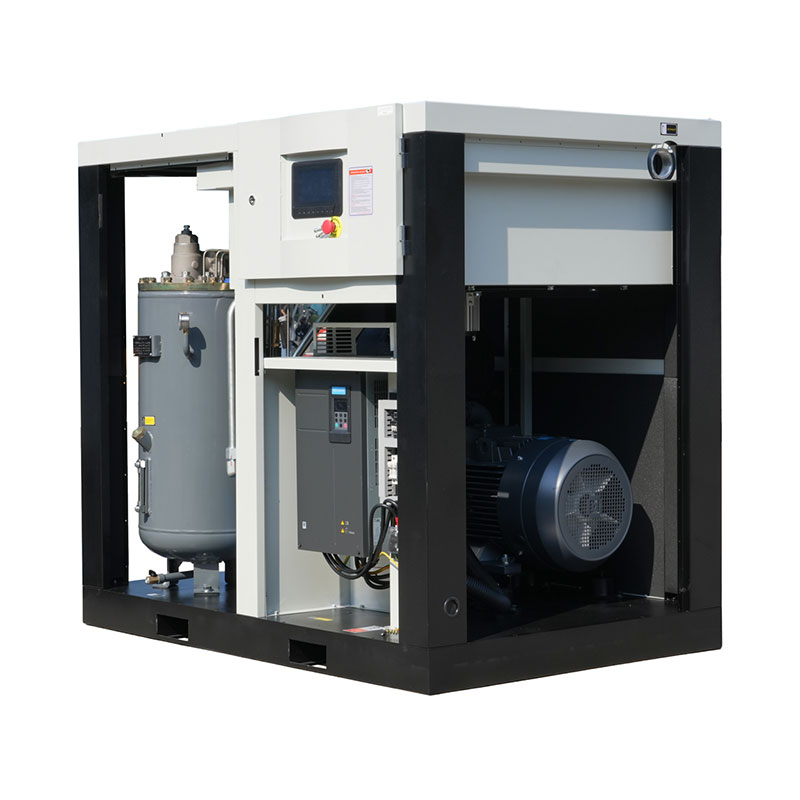
Moisture can be removed from an air compressor using a refrigerated dryer. Through a heat exchanger, the dry, cold air entering the pipe absorbs heat from the humid, high-temperature air, preventing condensation at the outlet and increasing volume while lowering relative humidity.
The humid, high-temperature air passes through the first-stage heat exchanger, transferring some heat to the cooled and dried output air, thus pre-cooling it. The second heat exchanger contains a refrigeration circuit where the evaporation of the refrigerant absorbs heat, further cooling the air.
In general applications, a compressed air temperature of 5°C is sufficient; however, modern methods can achieve an output temperature of 2°C. Input temperatures can be as high as 60°C, but pre-cooling to a lower input temperature is more economical.
When the air compressor is operating, air is drawn in through a self-cleaning air filter. The filter is automatically cleaned by a PLC. After automatic adjustment by the inlet guide vanes, the air enters the first stage of compression. The gas temperature after the first stage of compression is relatively high.
It then enters an intercooler for cooling (water flows inside the tubes, air flows outside; the intercooler water flow rate is specified in /h) before entering the second-stage compression system. To prevent gas from flowing back into the compression chamber (to avoid pressurized starting), a suspended full-opening check valve is installed in the compressor's exhaust pipe.
The gas discharged from the air compressor pushes open the check valve and enters the exhaust silencer, then the first-stage aftercooler, the second-stage aftercooler, and finally the main exhaust pipe. Air Compressor Wet with Water: What Causes Water to Enter the Air Compressor Oil Tank?
If water has entered the oil tank, it means the seal is not tight, and there is a problem between the lubricating oil and the water circuit. Checking and finding the leak point will solve the problem.
If this occurs during storage, it's a typical case of lubricating oil emulsification. If the air compressor is stored for a long time, it's best to drain the lubricating oil, or periodically (generally every 20-30 days) start the air compressor and let it run at full load for at least one hour. This will solve the problem.
If this occurs during operation, it's best to ensure the air at the air compressor's intake is dry. Also, check if your piping design is reasonable (the branch pipe's entry point into the main pipe should be higher than the main pipe's axis; otherwise, condensate from the main line can easily flow back into the air compressor). Another possibility is that the air compressor has been running at a low temperature for a long time.