
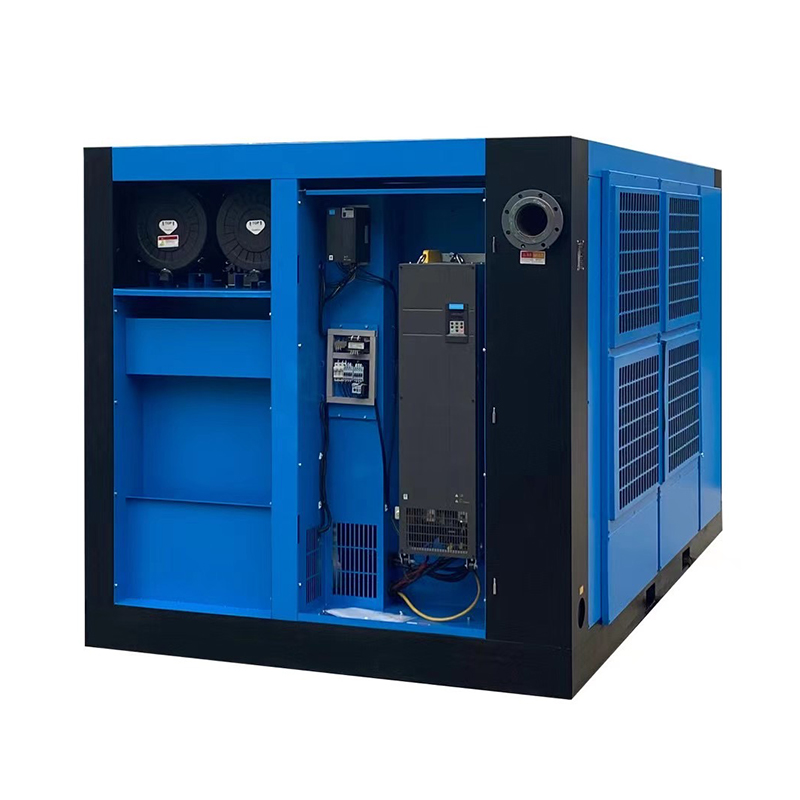
The rotor is the core component of a screw air compressor; the male rotor features four lobes (teeth), while the female rotor has six grooves. An oil film serves to protect the components and dissipate the heat generated by friction between the male and female rotors. The male rotor drives the female rotor to rotate. Under normal operating conditions—typically with an output pressure of 0.7 MPa (and an inlet pressure of 0)—the radial forces generated by the rotation of the rotors' helical lobes counteract this air pressure. Consequently, a clearance of 0.02 to 0.04 mm is maintained between the male and female rotors, ensuring they do not make direct physical contact. If the rotors were to rotate in reverse, the radial forces generated by their rotation would push the rotors toward the right. Simultaneously, the 0.7 MPa pressure at the inlet (assuming the outlet pressure is 0) would exert force on the rotors, also pushing them toward the right. As a result, the entire rotor assembly within the compressor head would shift to the right, causing friction between the rotor end faces and the interior of the compressor head casing. Furthermore, pressure would fail to build up within the compressor head, preventing the circulation of lubricating oil. Consequently, the heat generated by internal friction would not be dissipated; this heat accumulation would lead to dangerously high temperatures, causing deformation of both the rotors and the casing, resulting in the rotors seizing up, and ultimately leading to rotor wear or even catastrophic damage.
**Method for Checking Rotation Direction:** Occasionally, the phase sequence of the incoming power lines may be altered during shipment from the factory, or the power supply connected to the screw air compressor may change. Consequently, the phase sequence of the compressor's motor may also change. Therefore, it is highly recommended to use a phase sequence meter to verify the phase sequence and record the results. If a phase sequence meter is unavailable, you must exercise extreme caution and clearly label the wiring connections before disconnecting the power cables.
**If no prior records were made, the following checks should be performed before operating the air compressor:**
① Manually depress the contactor for the cooling fan to verify that the fan is blowing in the correct direction.
② If the power cables for the cooling fan have been moved or reconnected, manually "jog" (momentarily pulse) the main motor to verify that the motor coupling is rotating in the correct direction.