
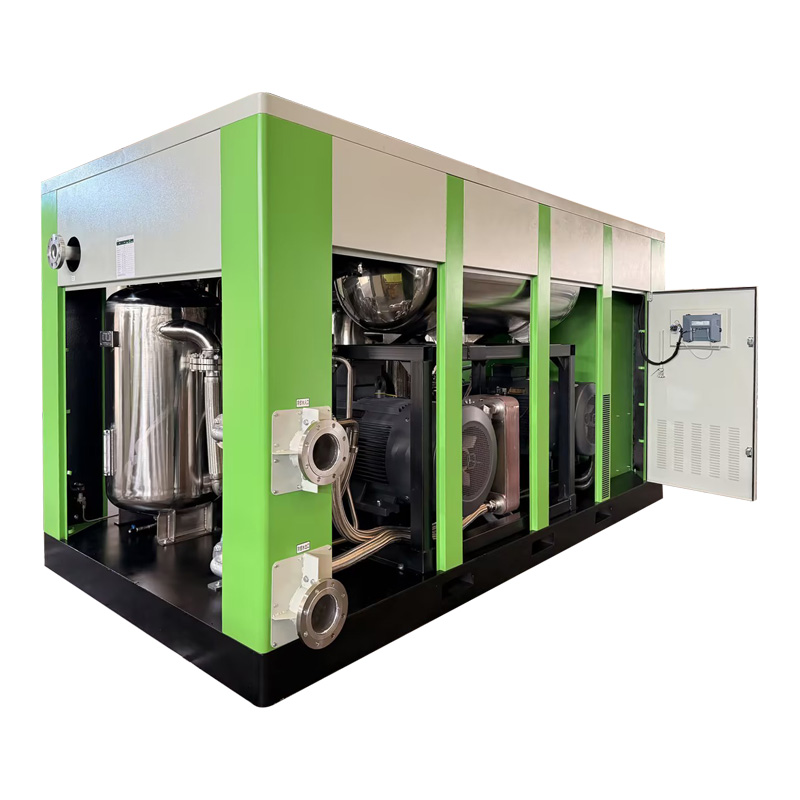
The widespread application of air compressor equipment has not only reduced labor costs but also significantly boosted corporate production efficiency. While selecting the appropriate air compressor is crucial, the design and installation of the compressed air piping system are equally important. Proper piping design and installation can minimize energy losses associated with the air compressor, reduce operational costs for the user, and extend the equipment's service life; therefore, understanding the correct procedures for piping installation is essential.
a. When installing piping, the main line must be laid with a slight downward slope to facilitate the drainage of condensate (moisture) from the pipes. The piping system should be equipped with drain valves, and regular draining procedures must be performed.
b. The pressure within the piping system must not exceed 5% of the compressor's set pressure; therefore, it is advisable to select a larger pipe diameter during installation.
c. Piping runs should be kept as short and straight as possible. The use of elbows and various types of valves should be minimized to reduce pressure loss within the system.
d. Branch lines must be connected to the *top* of the main line to prevent condensate accumulating in the main line from flowing down the pipes and entering the compressor unit.
e. The main line should not be arbitrarily reduced or expanded in diameter. If a change in diameter is necessary, a tapered reducer must be used; otherwise, the sudden change in cross-section can easily lead to significant pressure loss due to increased flow velocity. Furthermore, the resulting pressure shock from the gas flow can drastically shorten the service life of the piping system.
f. Consideration must be given to pressure loss—specifically, pressure drop—caused by long-distance piping runs. For factories with a relatively large number of air consumption points, a "ring-type" (closed-loop) air supply network can be installed. In such systems, the diameter of the main ring line should be increased to two to three times the diameter of the air compressor's outlet pipe. For ring-type systems, an air receiver tank may be installed at an intermediate point within the loop if deemed necessary.