
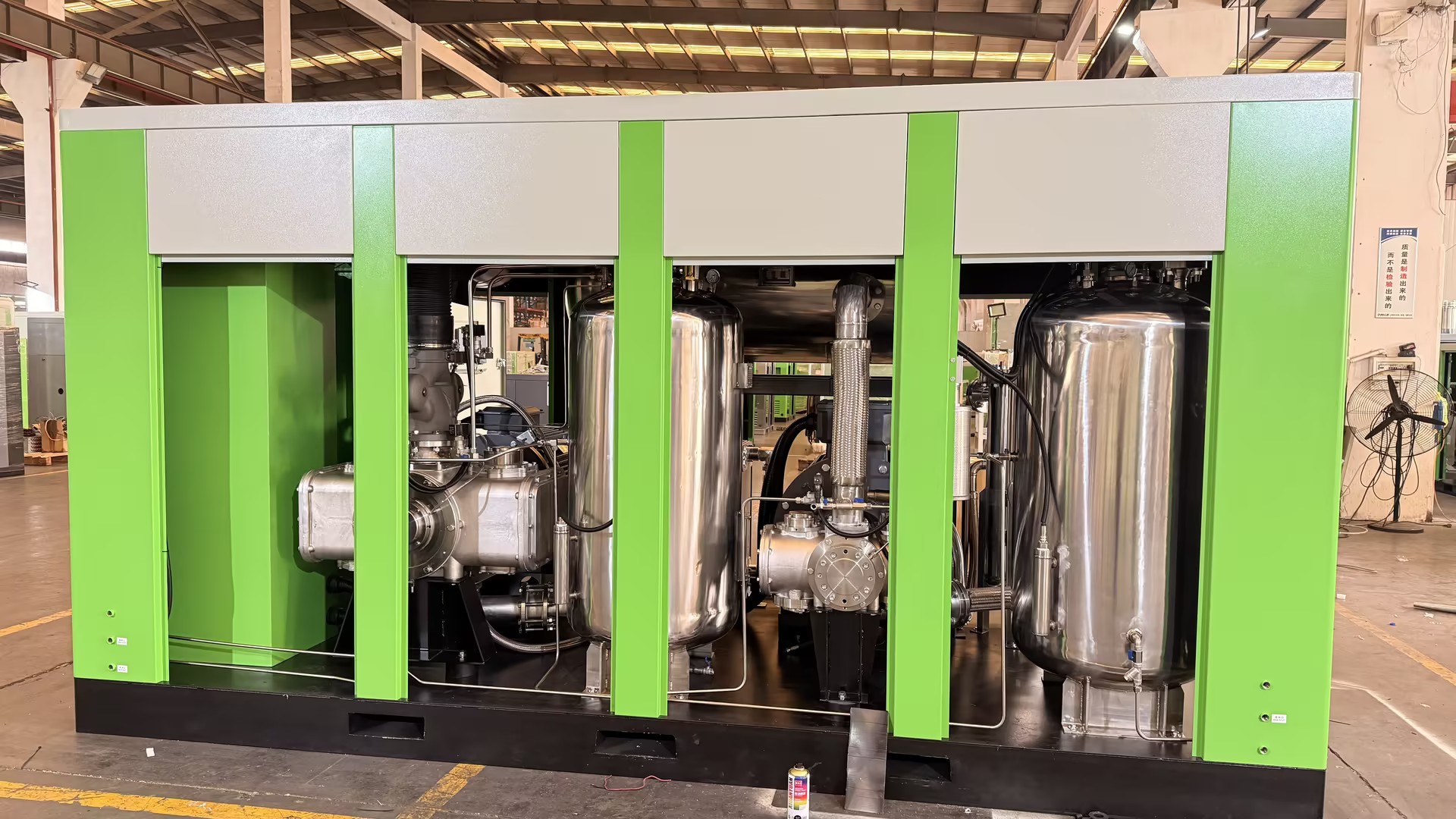
An air compressor station typically consists of three main modules: air generation equipment (air compressors), the air distribution pipeline system (air storage tanks, air purification equipment, and refrigerated dryers), and air-consuming equipment. Since the air-consuming equipment constitutes the energy-consuming component, the primary focus for energy conservation lies within the air generation equipment and the air distribution pipeline system.
The core principle of achieving energy conservation in an air compressor station is to ensure the stability of air supply volume, air quality, and air pressure at the point of use, thereby minimizing unnecessary energy consumption to achieve electricity savings. Data indicates that for most users, air demand fluctuates significantly—typically ranging between 45% and 80%. Consequently, to enhance productivity and reduce production costs, it is imperative to lower the energy consumption of the air compressor station.
Listed below are four common energy conservation strategies provided for your reference:
No. 1: Replace high-energy-consumption, low-efficiency piston-type air compressors with screw-type or scroll-type air compressors.
No. 2: Based on an assessment of actual on-site air usage conditions (specifically, whether the air volume and working pressure are subject to frequent, unstable fluctuations), consider replacing fixed-speed (utility-frequency) screw-type air compressors with variable-frequency drive (VFD) screw-type air compressors.
No. 3: Conduct regular inspections of the air distribution pipelines to detect leaks; promptly replace faulty fittings and rationally optimize the design of the pipeline network.
No. 4: Depending on the scale of the user's facility, consider installing an air compressor waste heat recovery system to capture and utilize the majority of the thermal energy generated during the air compression process. Typically, compressor stations dissipate this thermal energy into the atmosphere via air-cooling or water-cooling mechanisms; however, releasing this heat contributes to the atmospheric greenhouse effect and constitutes a waste of energy. By employing a waste heat recovery system, this otherwise wasted heat can be converted for use in various applications, such as heating domestic water, boiler preheating, space heating, and the production of industrial-grade pure water.