
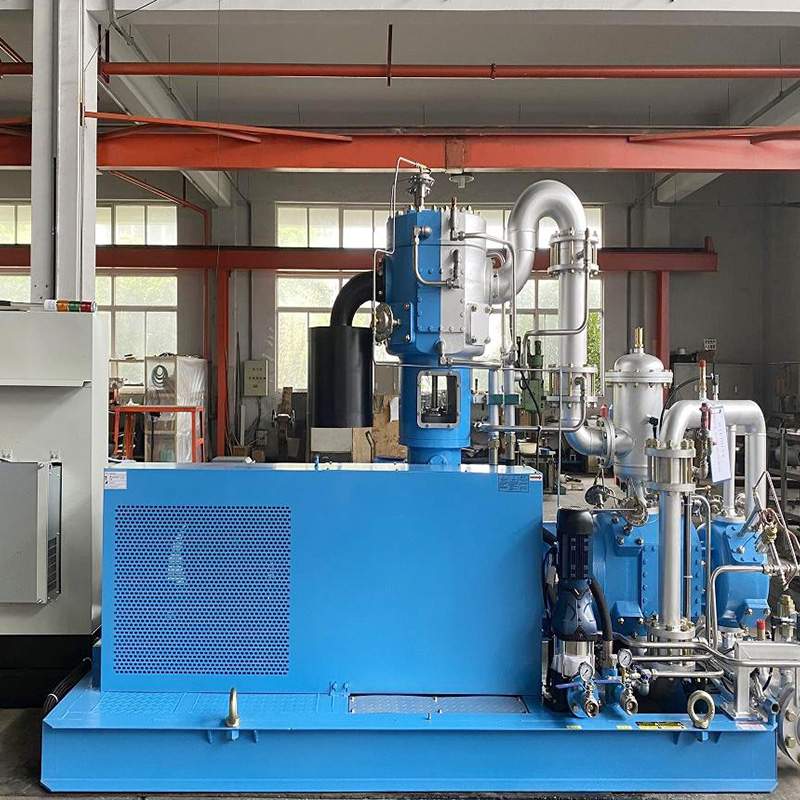
A variable frequency drive (VFD) air compressor is an energy-saving device that dynamically adjusts the speed of the main unit by using a frequency converter to alter the motor's power supply frequency in real-time. It precisely matches air output to actual demand, avoiding the massive energy waste caused by the frequent starting and stopping typical of traditional fixed-speed compressors, while ensuring constant supply pressure and reducing mechanical wear.
Based on the principles of electric motors, motor speed ($n$) is related to power supply frequency ($f$), the number of pole pairs ($p$), and slip ($s$), calculated by the formula: $n = \frac{60f(1-s)}{p}$. Adjusting the frequency ($f$) allows for smooth, stepless speed control.
Air Demand Sensing: The system monitors pipeline network pressure in real-time using pressure sensors.
Automatic Speed Adjustment: When air demand is high, the motor accelerates to increase output; when demand is low, it decelerates to reduce output, consistently maintaining the set pressure.
Key Advantages
High Efficiency and Energy Savings: Air output is directly proportional to motor speed; this effectively eliminates reactive power losses associated with "load/unload" cycles, achieving overall electricity savings of 20% to 35%.
Extended Service Life: The VFD provides a soft-start function, eliminating high inrush currents during startup and reducing wear on mechanical components and valves.
Constant Supply Pressure: Pressure fluctuations are minimal (typically $\le \pm 0.01$ MPa), ensuring stable air pressure for downstream production equipment and improving product quality.
Quiet Operation: Operating at lower speeds significantly reduces the compressor's overall noise level.
Classification and Application Scenarios
Permanent Magnet VFD: Utilizes a permanent magnet synchronous motor (PMSM), offering a more compact size and higher efficiency; currently the most widely used type in the screw air compressor sector.
Applicable Industries: Industrial scenarios that rely heavily on compressed air and experience significant fluctuations in demand, such as manufacturing, textiles, spray painting, and pneumatic automated production lines.