
Core Technology – Pressure Swing Adsorption (PSA)
The PSA nitrogen generator, also known as a pressure swing adsorption nitrogen generator, utilizes Pressure Swing Adsorption (PSA) as its core technology. This highly efficient gas separation technology has been rapidly adopted globally since its introduction in the late 1960s and early 1970s.
The principle of pressure swing adsorption is based on the differences in the "adsorption" performance of molecular sieves for different gas molecules. In PSA nitrogen generators, carbon molecular sieves are typically used as the adsorbent. Carbon molecular sieves are carbon-based adsorbents that combine certain properties of activated carbon and molecular sieves. They possess a rich microporous structure with pore sizes ranging from 0.3 nm to 1 nm. This unique pore structure allows smaller diameter gas molecules, such as oxygen, to diffuse more quickly into the solid phase of the molecular sieve, while larger diameter nitrogen molecules have relatively greater difficulty entering.
Adsorption Process: Achieving Nitrogen-Oxygen Separation
When air enters the PSA nitrogen generator as feedstock, it first undergoes a series of pretreatment steps. The air first passes through an air filter to remove dust and mechanical impurities, then enters an air compressor and is compressed to the required pressure. The compressed air then undergoes rigorous oil, water, and dust removal purification to ensure the cleanliness of the air entering the subsequent adsorption tower, preventing impurities from damaging the adsorbent and thus extending its service life.
The purified compressed air enters the adsorption tower containing carbon molecular sieves. Inside the adsorption tower, due to pressure, impurities such as oxygen, carbon dioxide, and water are preferentially adsorbed by the carbon molecular sieves. Nitrogen, due to its larger molecular diameter, diffuses more slowly within the carbon molecular sieves and is mostly not adsorbed, thus becoming enriched in the gas phase. As the adsorption process proceeds, the amount of oxygen and other impurities adsorbed by the carbon molecular sieves in the adsorption tower gradually increases. When a certain level is reached, the gas flowing out of the adsorption tower mainly consists of nitrogen and trace amounts of argon and oxygen, at which point the initial separation of nitrogen and oxygen is achieved.
Regeneration Process: Adsorbent Recycling
After a period of time, the carbon molecular sieve in the adsorption tower reaches an equilibrium state in its adsorption of impurities such as oxygen. At this point, regeneration is necessary to restore its adsorption capacity and enable recycling. Based on the characteristic that the adsorption capacity of carbon molecular sieves varies under different pressures, the PSA nitrogen generator reduces the pressure in the adsorption tower, causing the carbon molecular sieve to release the adsorption of impurities such as oxygen. This process is called regeneration.
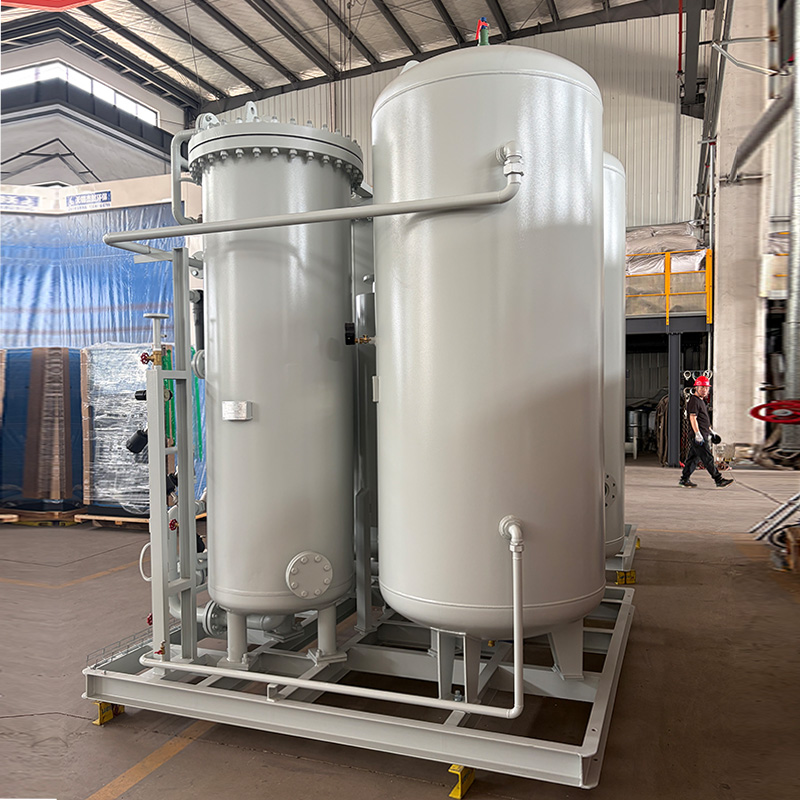
In actual operation, the PSA nitrogen generator is typically equipped with two adsorption towers. While one tower adsorbs and produces nitrogen, the other tower simultaneously undergoes depressurization desorption and regeneration. When the adsorption process in one tower is complete, the system automatically switches, allowing the regenerated tower to begin adsorption, while the tower that has just completed adsorption begins its regeneration process. Through this alternating cyclical operation, the PSA nitrogen generator can achieve a continuous and stable output of nitrogen.
Specifically, the regeneration process generally includes the following steps: First, depressurization, which rapidly reduces the pressure inside the adsorption tower to atmospheric pressure, causing the oxygen and other impurities adsorbed by the carbon molecular sieve to begin desorption; then, rinsing is performed, usually by introducing some of the produced pure nitrogen gas to purge the adsorption tower, completely carrying away the desorbed impurities from the adsorption tower and discharging them into the atmosphere, thereby fully regenerating the carbon molecular sieve and preparing it for the next round of adsorption.