
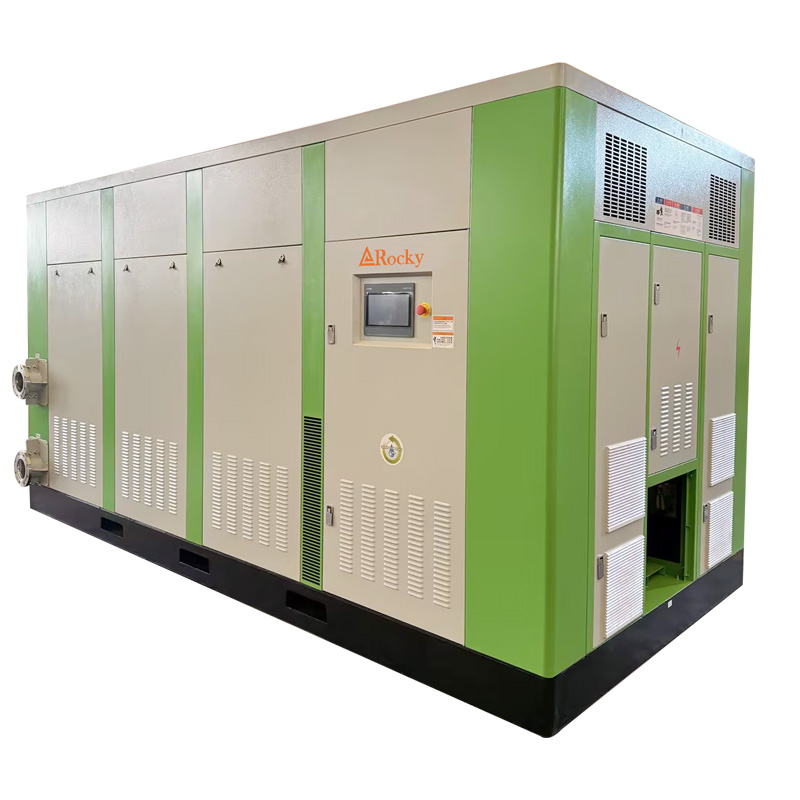
Pressure Swing Adsorption (PSA) nitrogen generation technology typically uses PSA carbon molecular sieves as the adsorbent. The adsorption rates of oxygen and nitrogen by carbon molecular sieves differ significantly. Under short-term pressurization, the adsorption rate of oxygen far exceeds that of nitrogen. A large number of oxygen molecules are adsorbed by the carbon molecular sieve, while very few nitrogen molecules are adsorbed. This characteristic is utilized to achieve oxygen-nitrogen separation. The adsorption capacity of the carbon molecular sieve for oxygen decreases as the pressure decreases. Reducing the pressure allows the adsorbed oxygen molecules to escape from the carbon molecular sieve, passing through the silencer at the bottom of the tower and being discharged into the atmosphere, thus desorbing and regenerating the carbon molecular sieve. In addition, carbon molecular sieves also have the ability to adsorb carbon dioxide and moisture, and desorption is relatively easy. Typically, PSA nitrogen generators use dual adsorbents in parallel, alternating adsorption to produce nitrogen, followed by desorption and regeneration, achieving oxygen and nitrogen separation and continuous gas supply.
Nitrogen Generator Pressure (Bar/MPa): The outlet pressure of conventional nitrogen generators is generally 0.1-0.7 MPa, which is adjustable. However, some industry processes require nitrogen pressures higher than 0.7 MPa. In these cases, a booster compressor is needed to pressurize the nitrogen to the required pressure. The outlet pressure of the nitrogen is also important.
Nitrogen generator flow rate (Nm³/h): Flow rate refers to the volume of nitrogen produced by the nitrogen generator per minute or hour, usually expressed in cubic meters (m³). Currently, nitrogen generators on the market can produce flow rates ranging from a few cubic meters per hour to tens of thousands of cubic meters per hour. Users can refer to the amount of bottled nitrogen they need or the design specifications of the design institute when selecting a nitrogen generator.
The pressure of the nitrogen generator has a certain impact on the flow rate. The nitrogen generator separates nitrogen and oxygen from compressed air to obtain nitrogen. A decrease in compressed air flow rate will also reduce the nitrogen flow rate. Of course, if the compressed air flow rate is not lower than the required level for the nitrogen generator, it is difficult to reduce the flow rate.
(1) For the inlet buffer tank, the nitrogen generation process of the nitrogen generator can be considered as having only two processes: pressure equalization and adsorption. During the pressure equalization process, the pressure in the buffer tank rises rapidly. In the initial stage of adsorption, the pressure in the inlet air buffer tank drops sharply, reaches its minimum value after a period of time, and then rises slowly. The change pattern of the inlet flow rate is exactly the opposite of that of the pressure.
(2) Increasing the pressure of the inlet air buffer tank can better utilize the buffering effect of the inlet air buffer tank and the instrument air storage tank. This not only increases the flow rate and pressure of the product gas but also better utilizes the adsorption performance of the adsorbent. Therefore, under the premise of ensuring oxygen content, the pressure of the inlet air buffer tank should be increased as much as possible.
(3) To reduce the impact of instrument air duct network pressure changes on the oxygen content and flow rate of the product gas, the valves downstream of the nitrogen generator to the gas consumption network should be closed as much as possible while ensuring nitrogen production, to prevent excessive upstream pressure or insufficient downstream pressure from causing excessive oxygen content.
(4) Under the condition that other factors remain unchanged, the higher the pressure of the outlet nitrogen buffer tank, the more stable the outgoing nitrogen flow rate and the lower the oxygen content. During operation, the pressure of the outlet nitrogen buffer tank should be increased as much as possible.