
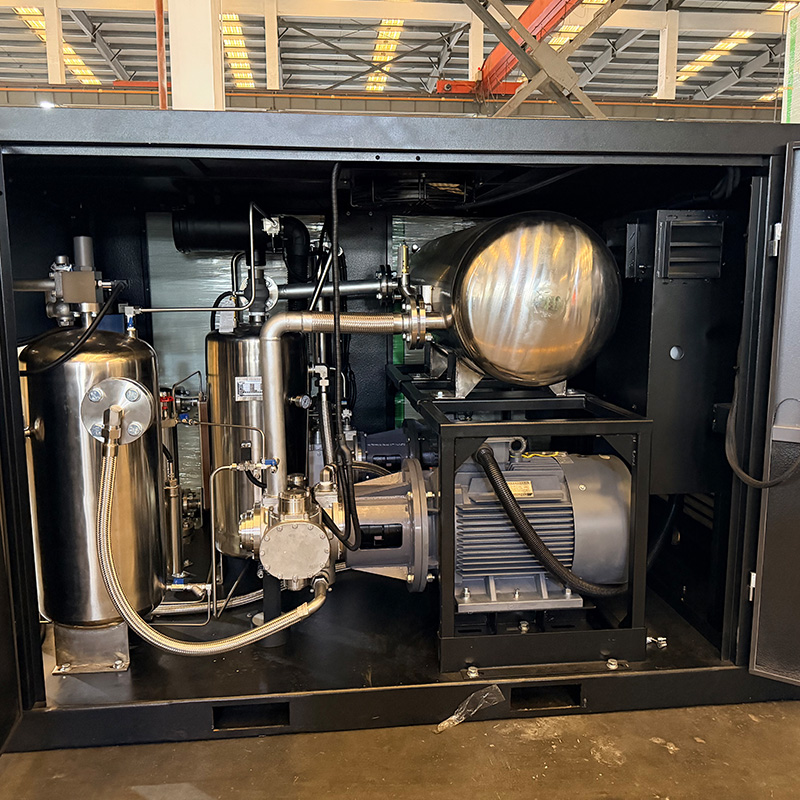
The core of an oil-free screw compressor consists of the screw air-end—specifically the intermeshing male and female rotors—along with essential components such as synchronization gears, bearings, shaft seals, and the compressor housing, all of which ensure oil-free, high-speed, and high-precision operation.
Key components include:
Male and Female Rotors: A pair of parallel, helically shaped, intermeshing rotors (the male rotor typically features convex lobes, while the female rotor has concave grooves). Gas compression is achieved through volume changes within the interlobe spaces. The rotor surfaces are often treated with specialized coatings to enhance wear resistance, provide corrosion protection, or reduce friction.
Synchronization Gearbox: In oil-free screw compressors, the rotors do not make direct contact to transmit power. Instead, high-precision synchronization gears drive the rotors to rotate in opposite directions, maintaining a precise, stable gap between them to prevent friction and wear.
High-Precision Bearing System: This system supports the rotors, ensuring smooth, high-speed operation. It manages both axial and radial loads while maintaining the critical, precise clearances between the rotors and the housing, as well as between the rotors themselves.
Shaft Seal Assembly: This component isolates the compression chamber from the gearbox and bearing housings. It prevents lubricating oil from the gears or bearings from migrating into the compression chamber—which would contaminate the gas—and simultaneously prevents the compressed gas from leaking out.
Housing and End Covers: These components enclose the rotors and incorporate intake ports, discharge ports, and cooling channels. The machining precision of the internal surfaces directly influences internal leakage rates and overall compression efficiency.
Cooling and Valve Systems: Because oil-free compression lacks the cooling benefits provided by lubricating oil, these systems typically require independent air-cooled or water-cooled heat exchangers to regulate discharge temperatures. Additionally, intake and discharge valves are used to control the flow of gas.