
Class 0 oil-free 40 bar compressor for PET stretch blow molding: 20 m³/min, 250 kW, ISO 8573-1 Class 0 air. Built for 24/7 lines.
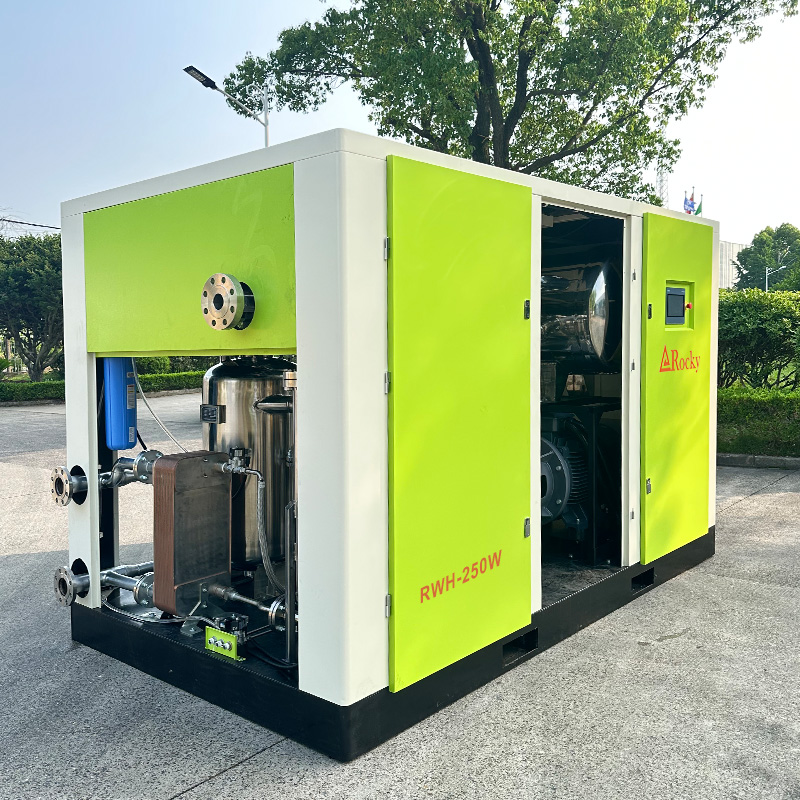
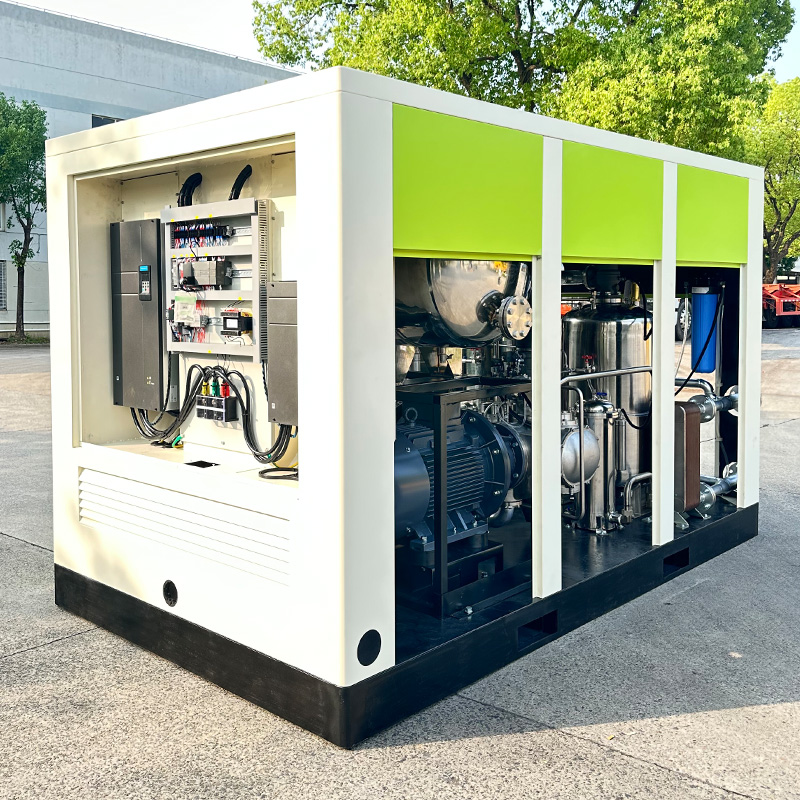
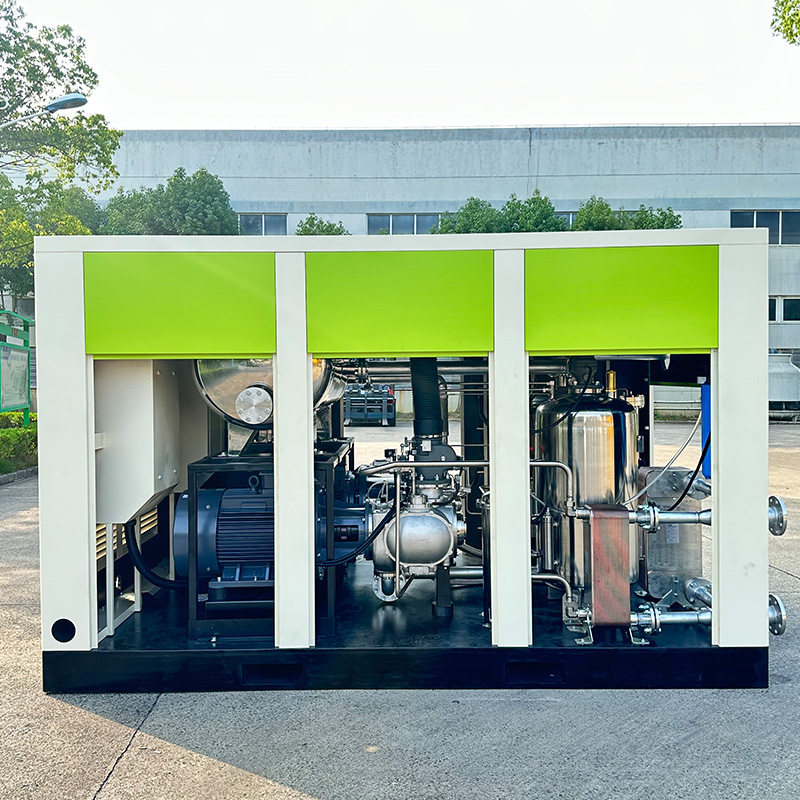
Class 0 oil-free air. Stable 40 bar at the blow valve. No oil to buy, change or dispose of.
| 40 bar working pressure | 250 kW motor | 20m³/min free air delivery | ISO 8573-1 Class 0 |This oil‑free rotary screw compressor operates with water‑based lubrication and is driven by a permanent‑magnet variable‑speed motor. In place of conventional oil, the system circulates purified water or a water‑based fluid, which ensures that the discharged air contains zero oil contamination. Such clean output makes the unit ideal for industries that demand exceptionally pure air.
Oil-free, water-injected 40 bar air compressor for PET stretch blow molding.
20.0 m³/min (706 cfm) at 40 bar, 250 kW total (90 kW + 160 kW two-stage),
water-cooled, ISO 8573-1 Class 0 — no oil carry-over into the blow air.
Typical fit: multi-cavity PET lines for 0.5–1.5 L CSD and water bottles.
Lead time 25–35 working days · FAT before shipment · commissioning support available.
The RWH-250W is a two-stage, oil-free screw compressor that uses water instead of oil as the lubricant and sealant in the compression chamber.
It delivers 20.0 m³/min at 40 bar from a 250 kW drive — the class of machine used on multi-cavity PET lines running 0.5–1.5 L bottles around the clock.
Because no oil enters the compression chamber, the air leaves the machine at ISO 8573-1 Class 0 for oil content — the class required by most
food, beverage and pharmaceutical blow-molding specifications. Water is separated, filtered and recirculated inside the unit. The cooling circuit is separate from the process water and needs no oil top-up. The machine is built for continuous duty: IP55 motors, Class F insulation, direct drive, water cooling rated to 45 °C ambient, and a soft-start VFD that limits inrush on 380 V supplies. Water filter, air filter and water treatment cartridge are the routine service items; there is no oil circuit to maintain.
Blow pressure is set by the bottle design and the mould, not by the purchase budget.
The same machine produces more air and draws less shaft power as pressure drops, so the question is always: what is the lowest pressure your
mould is qualified for?
40 bar — standard water and CSD bottles. Baseline for flow and power. Default for new lines.
35 bar — lightweight, thin-wall bottles with optimised moulds. Flow +3–5%, shaft power −5%.
30 bar — wide-mouth jars, some hot-fill lines, machines with low pre-blow demand. Flow +5–8%,
shaft power −9%. On high-volume lines this is the cheapest efficiency measure available: the saving is electricity, not machine price.
25 bar — only where the blowing machine and mould are qualified for it. Flow +8–12%, shaft power −13%. Never a purchasing decision on its own.
Lower pressure always requires confirmation: check wall thickness and burst pressure on bottle samples before committing, and confirm delivered
flow and specific power for each pressure point against the ISO 1217 test report for the quoted model.
ISO 8573-1 Class 0 is the strictest oil-content class in the standard, and it is only meaningful when it is measured at the point of use — not at the
compressor outlet. A water-injected compressor has no oil in the compression chamber, so the air leaves the machine oil-free by design rather than
by filtration. That is the difference between“Class 0 compressor” and “Class 0 system”: a coalescing filter downstream of an oil-lubricated machine can reach low oil carry-over, but it
cannot guarantee zero, and it adds pressure drop and maintenance.
For blow molding this matters twice: oil in the blow air migrates to the bottle surface and, in food and beverage filling, becomes a contamination
and taste risk. Specify Class 0 at the blowing machine inlet, and keep the dryer and filters sized for the full 20 m³/min.
At 40 bar the RWH-250W draws 250 kW; the annual electricity bill, not the purchase price,is the dominant cost over a ten-year life. Two levers matter:
Pressure — dropping from 40 to 30 bar cuts shaft power by roughly 9% at constant flow, because compression work follows ln(p₂/p₁). On a line
running 6,000 h/year that is a measurable saving for a change that costs nothing in hardware.
Part-load control — the soft-start VFD matches motor speed to demand instead of loading and unloading at fixed speed. On lines with shift-based
demand, the saving is typically larger than the pressure effect.
Maintenance for the oil-free water-lubricated screw air compressor primarily involves water and filters instead of oil. The routine service schedule
consists of a water filter replacement (every 800–1,000 hours), an air filter replacement (every 2,000 hours), and a water treatment inspection
(every 8 hours). Most importantly, this eco-friendly design requires no oil changes, no waste oil disposal, and no separator element replacements,
ensuring maximum uptime and lower total cost of ownership.
In a two-stage PET blowing system the compressor is the high-pressure stage. It takes air from the plant header or from a pre-compression stage,
raises it to 40 bar, and delivers it through a high-pressure receiver and dryer to the blowing machine.
What to plan around: a buffer vessel sized for the blow cycle (the mould draws a large instantaneous flow for a fraction of a second), a dryer rated
for the full flow at 40 bar, and filtration that does not add more than 0.2 bar pressure drop. The air outlet is DN65 and the cooling water connection
is DN80 at 52 t/h — both matter at the layout stage, not after the foundation is poured.
If the line runs several moulds, size the receiver and the header for the sum of the simultaneous blows, not the average consumption.
Standard lead time is 25–35 working days after specification confirmation and down payment. Machines ship in export-grade fumigation-free
wooden cases; weight and dimensions are confirmed in the packing list before dispatch.
Before shipment we run a factory acceptance test and send the report with the machine: free air delivery, pressure hold, water circuit, control
sequence.
Documentation includes the operation manual, electrical and P&ID drawings, and the spare-parts list — English as standard, Russian and other
languages on request.
On site, commissioning support is available: installation supervision and start-up by our engineer, or remote guidance by video for standard
stations. Operator training covers start-up, water treatment and the maintenance schedule.
For technical support or inquiries, please leave your contact information.